Skip to product information
1 of 7

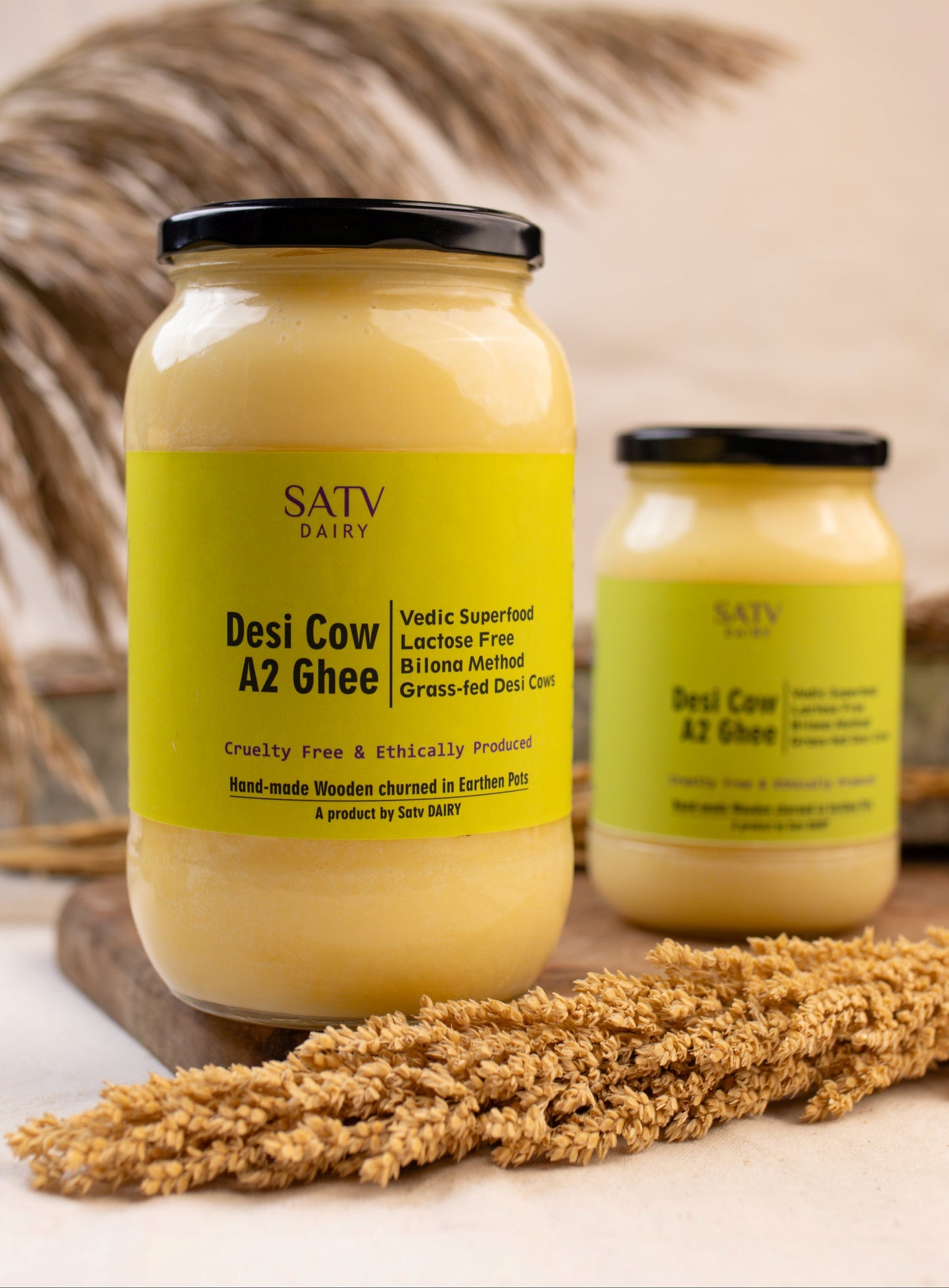
Desi Cow A2 Ghee (Grass-fed)

Desi Cow A2 Ghee (Grass-fed)

Regular price ₹ 5,400
Regular price Sale price ₹ 5,400
Sale Sold out Best Seller
Shipping calculated at checkout.

Hand-churned using traditional Bilona method from ethically raised desi cows.

Bilona Crafted
Bilona Crafted
Pure A2 Cow Milk
Pure A2 Cow Milk
Rich Aroma & Taste
Rich Aroma & Taste
Satv Dairy Trusted
Satv Dairy Trusted
Selected Size: 1 L

Most Popular ₹ 5,400

Best for Trial ₹ 2,790

Quantity
Secure Checkout
100% safe payments

Next-day delivery across Delhi-NCR

Order before 6:00 PM for delivery the next day. Orders placed later will be delivered the following day.

View full details

Desi Cow A2 Ghee (Grass-fed)

Rs. 2,790.00

Quantity
BUY IT NOW
Free Shipping

Free Shipping

above 2499

Easy Returns

Easy Returns

Hassle-free

Ship within

Ship within

24 Hours

Direct from Farm

Direct from Farm

No Middlemen

Lab Tested

Lab Tested

& Certified

WHY IS THIS DIFFERENT?

Made from Pure A2 Desi Cow Milk

Made from Pure A2 Desi Cow Milk

Traditional Bilona Churning Method

Traditional Bilona Churning Method

Slow-Cooked for Rich Aroma & Taste

Slow-Cooked for Rich Aroma & Taste

No Preservatives or Artificial Additives

No Preservatives or Artificial Additives

Naturally Rich in Healthy Fats

Naturally Rich in Healthy Fats

DESCRIPTION DESCRIPTION

There's a particular smell that hits you when someone opens a jar of real ghee warm, nutty, slightly sweet and you know immediately whether it's the real thing or just the commercial version that looks the same but smells like nothing much.

That smell comes from how the ghee is made, not just what it's made from.

Satv Dairy's Desi Cow A2 Bilona Ghee follows the full traditional route. Grass-fed indigenous cows Gir, Sahiwal, and Haryana breeds on our own farm give fresh A2 milk. That milk is into curd. The curd is hand-churned using a wooden bilona in earthen pots to separate white makhan. The makhan is then gently heated in stages slow, careful, no rushing until pure golden ghee forms.

That's four steps from milk to ghee. And it takes approximately 45 litres of milk to produce just 1 kg of this ghee. Which is exactly why most commercial brands skip the process entirely and go straight from cream to ghee it's cheaper, faster, and produces far more per litre. The result just doesn't smell or taste the same.

No preservatives, no additives, no shortcuts. Naturally lactose-free, gluten-free, no trans fats. 12-month shelf life, no refrigeration needed. Just ghee, made the way it's been made for generations and still worth making that way.

BENEFITS BENEFITS

1. Grass-fed desi cows full season, outdoors:

  • Our Gir, Sahiwal, and Haryana cows graze on natural grass and fodder. Grass-fed A2 cow ghee has a deeper golden color from natural beta-carotene the color isn't added, it comes from what the cows eat.

2. Curd-route, not cream-route:

  • Commercial ghee skips from cream directly to heated fat. Bilona ghee goes: milk → curd → hand-churned makhan → slow-heated ghee. Traditional wooden bilona churning in earthen pots the longer route is why the taste and aroma are different.

3. Naturally lactose-free:

  • The slow heating process removes milk solids completely. What remains is pure clarified fat with no lactose. Suitable for people who usually avoid dairy because of lactose sensitivity.

4. 45 litres for 1 kg nothing wasted, nothing added:

  • That ratio is the honest cost of doing this properly. No fillers, no milk powder, no adulteration to increase yield. Small batch A2 bilona ghee every jar accounts for its milk.

5. Grainy texture the real test:

  • Genuine bilona ghee from grass-fed desi cow milk solidifies with a natural grainy texture at cooler temperatures. If your ghee is always smooth like refined oil, it was likely made from cream with no curd step involved.

6. Cruelty-free, ethically made:

  • Our cows are not given hormones or oxytocin. The calf feeds first, always. The ghee is made from milk that was given naturally which matters both ethically and in the final quality of what you eat.
HOW IT'S MADE HOW IT'S MADE
  1. Fresh grass-fed A2 milk, same morning. From Gir, Sahiwal, and Haryana cows that graze on natural fodder on our own farm.
  2. Turned into curd overnight. The milk is naturally a traditional starter and left to set. This is the step most commercial ghee skips entirely going from cream to ghee cuts out everything that happens here.
  3. Hand-churned in earthen pots with a wooden bilona. The curd is churned by hand using a traditional wooden bilona not a machine, not an electric churner. White makhan rises gradually and is carefully collected. This step alone takes time and effort that simply can't be rushed.
  4. Makhan slow-heated in stages until ghee forms. The white makhan is gently heated multiple times. Milk solids separate, foam rises, the ghee clarifies to a deep golden colour with that characteristic nutty aroma. no preservatives, nothing added.
HOW TO USE HOW TO USE
  1. A spoon of this on ho t dal-chawal is one of those small daily things that genuinely improves your meal the ghee melts in, the aroma hits, and it tastes like food made with actual care. On a roti straight off the tawa, even better.
  2. Use it for tempering (tadka) the high smoke point means it handles heat without burning or smoking excessively. For cooking and sautéing, it adds depth that refined oil just doesn't. For traditional sweets and halwa during festivals, it's irreplaceable. A small spoon in warm milk before bed is still one of the oldest remedies in Indian households for a reason.
  3. Because it's naturally lactose-free, people who usually avoid dairy for digestion reasons can typically use this without any issue.
  4. No refrigeration needed store in a cool, dry place.
  5. Always use a clean, dry spoon moisture is the main enemy.
  6. Keep the lid tightly closed after each use.
  7. Shelf life: 12 months from production date.
  8. Ghee that solidifies and turns slightly grainy in winter is normaland a good sign.
INGREDIENTS INGREDIENTS
  • Vedic Bilona A2 White Makhan. One ingredient. That's it.
FAQS FAQS

1. What's the actual difference between Bilona ghee and regular commercial ghee?

  • Commercial ghee is almost always made by separating cream from milk and heating it directly efficient, scalable, cheap per litre.
  • Bilona ghee goes through an entirely different route: milk is turned into curd, the curd ishand-churned to extract white makhan, and only that makhan is slowly heatedinto ghee. The process takes roughly 45 litres of milk per kilogram of ghee.The difference shows up in three things: aroma (noticeably deeper and nuttier),texture (naturally grainy when cool), and colour (golden from naturalbeta-carotene in grass-fed milk, not from colouring).

2. Why does it take 45 litres of milk to make 1 kg of ghee?

  • Because every stage loses volume. Milkbecomes curd. Curd is churned and most of it becomes buttermilk only the fatrises as makhan. That makhan is then heated and the remaining moisture and milksolids are removed. What's left is pure clarified fat no water, no solids,nothing. The 45-litre ratio is an honest reflection of the process. Brands thatproduce ghee at a lower milk-to-ghee ratio are either using cream (which skipsthe curd stage entirely) or adding fillers.

3. My ghee has turned grainy / solid in winter — is something wrong?

  • Nothing is wrong it's a good sign. Puredesi cow bilona ghee solidifies and develops a slightly grainy, crystallinetexture when temperatures drop. This is a natural characteristic of ghee madefrom grass-fed A2 cow milk with no additives. If your jar is solid in Decemberand liquid in May, it's doing exactly what real ghee does.

4. Is it suitable for people who are lactose intolerant?

  • Yes, for most people. The slow multi-stageheating process removes milk solids and lactose almost entirely. What remainsis pure fat. Most people with lactose sensitivity handle ghee well preciselybecause of this. That said, if you have a severe dairy allergy (not justlactose sensitivity), check with your doctor before using any ghee.

5. Does it need refrigeration? How long does it last?

  • No refrigeration needed. Store in a cool,dry place, away from direct sunlight, and always use a clean dry spoon. Shelflife is 12 months from production. The absence of moisture and milk solids iswhat makes ghee naturally shelf-stable just keep water out of the jar and itwill last.

6. How do I check if the ghee is pure at home?

  • Heat a small spoon of ghee over low flame. Pure bilona ghee melts quickly, turns deep golden, and smells nutty. It should leave no white or oily residue.

WATCH THE BILONA A2 GHEE PROCESS

See how we handcraft our Grass-Fed Desi Cow A2 Ghee using the traditional Bilona method to preserve its rich aroma, purity, and natural goodness.

FREQUENTLY BOUGHT TOGETHER